

Runes
Ancient Symbols, Modern Intuition & My Journey With the Runes
There is something about runes that feels a little bit different.
Maybe it’s the shapes — those beautiful angular symbols that look as though they have been carved straight out of an ancient forest.
Maybe it’s the history.
Maybe it’s the mystery.
Or perhaps, like me, you simply pick up a rune and think:
“Okay… what are you trying to tell me?”
For me, runes sit beautifully at the meeting point between history, symbolism and intuition. They are ancient, but they don't feel stuck in the past. In fact, I find them incredibly relevant to modern life because, underneath all the symbolism, they ask us to do something we don't always make time for anymore:
Pause. Listen. Look within.
So, let's go down the rabbit hole — rune style.
What exactly are runes?
At their most basic level, runes are an ancient writing system used by Germanic peoples.
They weren't originally created as a set of mystical fortune-telling symbols. They were letters — a way of writing.
The word futhark comes from the first six sounds/letters of the runic sequence:
F – U – Þ – A – R – K
The strange-looking Þ represents a "th" sound, which is why futhark is pronounced roughly as "foo-thark."
The earliest runic systems developed during the first centuries after the birth of Christ. Archaeological evidence suggests the script was influenced by Mediterranean alphabets, particularly through contact with the Roman world, but people in northern Europe adapted those influences into their own writing system.
And here's something I absolutely love:
Runes were designed to be carved.
Think wood, stone, bone, metal and everyday objects.
Those beautiful angular lines weren't just there because they looked mystical and fabulous. They were practical. Straight lines are considerably easier to carve into wood than beautiful rounded letters.
So yes, even the Vikings were working with a minimalist aesthetic.
Scandi chic was apparently alive and well.
Where did the runes originate?
Runes originated in Northern Europe, within the Germanic-speaking world, and their earliest development is generally placed around the first centuries CE.
The oldest major runic system is what we now call the Elder Futhark, containing 24 characters. It was used during the Iron Age and continued for several centuries before later runic alphabets developed.
Later, during the Viking Age, the Younger Futhark emerged, containing only 16 runes. This might sound odd — surely you'd expect languages to add letters rather than lose them?
But language had changed, and the writing system changed with it. The Viking-Age runes were adapted to represent the sounds people were using at that time.
Runes weren't restricted to one tiny corner of Scandinavia either.
As people travelled, traded and migrated, runic inscriptions appeared across a much wider geographical area. Viking-Age runes have been found in places including England, Greenland, Russia and beyond.
And that is one of the things I find fascinating.
These little symbols travelled.
They crossed borders.
They were carved into objects.
They carried names, messages, memories and stories.
What were runes actually used for?
This is where I think we need to separate historical runes from the modern idea of rune readings.
Historically, runes were used for very ordinary things.
Names. Ownership. Memorials. Messages. Commemorations. Warnings.
They were carved onto objects such as weapons, jewellery, combs and other personal items. Rune stones were also erected to commemorate people and their achievements.
Some rune stones are essentially ancient versions of:
"Dave was here."
Except Dave had considerably more impressive landscaping.
Rune stones could tell us who someone was, who they were related to, what they had achieved and sometimes how they died.
The famous Jelling stones in Denmark, for example, are incredibly important historical monuments and tell us about the transition from the Viking world towards Christianity and the emergence of Denmark as a kingdom.
So when we work with runes today, we're connecting with symbols that have a very real historical story behind them.
But were runes magical?
Now we get to the juicy bit.
Yes… and also, it's complicated.
There are historical and literary sources connecting runes with magic, protection, healing, curses and divination. The Old Norse poem Hávamál, for example, tells the famous story of Odin gaining knowledge of the runes after hanging upon the tree for nine nights.
But historians are careful here.
The evidence does not support the idea that every Viking walked around carrying a little rune pouch and doing daily tarot-style readings.
In fact, the National Museum of Denmark points out that most surviving runic inscriptions are much more ordinary — names, messages and practical inscriptions — while the evidence for organised "rune casting" as we imagine it today is much less straightforward. Some accounts of runic magic come from later medieval literature and sagas.
And I actually love that distinction.
Because it allows us to respect the history without pretending we know something that we don't.
For me, that makes the modern spiritual use of runes even more interesting.
We aren't necessarily recreating exactly what someone did 1,500 years ago.
We're taking an ancient symbolic language and developing a modern intuitive relationship with it.
So how are runes used today?
Modern rune readers often work with the 24 Elder Futhark runes.
Each rune has a name, sound and traditional associations.
For example:
ᚠ Fehu — abundance, wealth, resources
ᚢ Uruz — strength, vitality, courage
ᚨ Ansuz — communication, wisdom, messages
ᚷ Gebo — gifts, partnership and exchange
ᛃ Jera — harvest, cycles and reward
ᛉ Algiz — protection and awareness
ᛚ Laguz — intuition, emotion and flow
ᛞ Dagaz — breakthrough, awakening and new beginnings
And this is where I personally love working with them.
I don't see a rune as saying:
"This WILL happen."
I see it more as asking:
"What energy is present here, and what are you being invited to understand?"
That distinction matters.
Because I don't believe spirituality should take away our personal power.
A reading shouldn't tell you what you're allowed to do with your life.
It should help you look at your situation from another perspective.
My relationship with the runes
And now we get personal.
My relationship with runes has grown through my wider journey with intuition, energy and spiritual work.
I've always been fascinated by the language of symbols.
Give me a pendulum, crystals, colours, numbers, a photograph, an aura or a set of runes and my brain immediately goes:
"Ooooh… let's investigate."
But I've also learned over the years that intuition isn't about blindly believing every thought that pops into your head.
For me, intuition is about learning to listen.
And that's where the runes became particularly interesting.
When I first started working with them, I could have simply memorised a list of meanings.
Fehu means this.
Uruz means that.
Laguz means this.
Done.
But that wasn't enough for me.
Because when you're intuitive, you start noticing something.
Sometimes you look at a rune and the textbook meaning isn't the first thing that comes through.
You might notice the shape.
You might feel an emotion.
A word might pop into your head.
You might suddenly think about a particular person or situation.
Or you might look at the rune and simply get that very clear:
"Nope. Not this."
And that, for me, is where the magic happens.
The rune bag
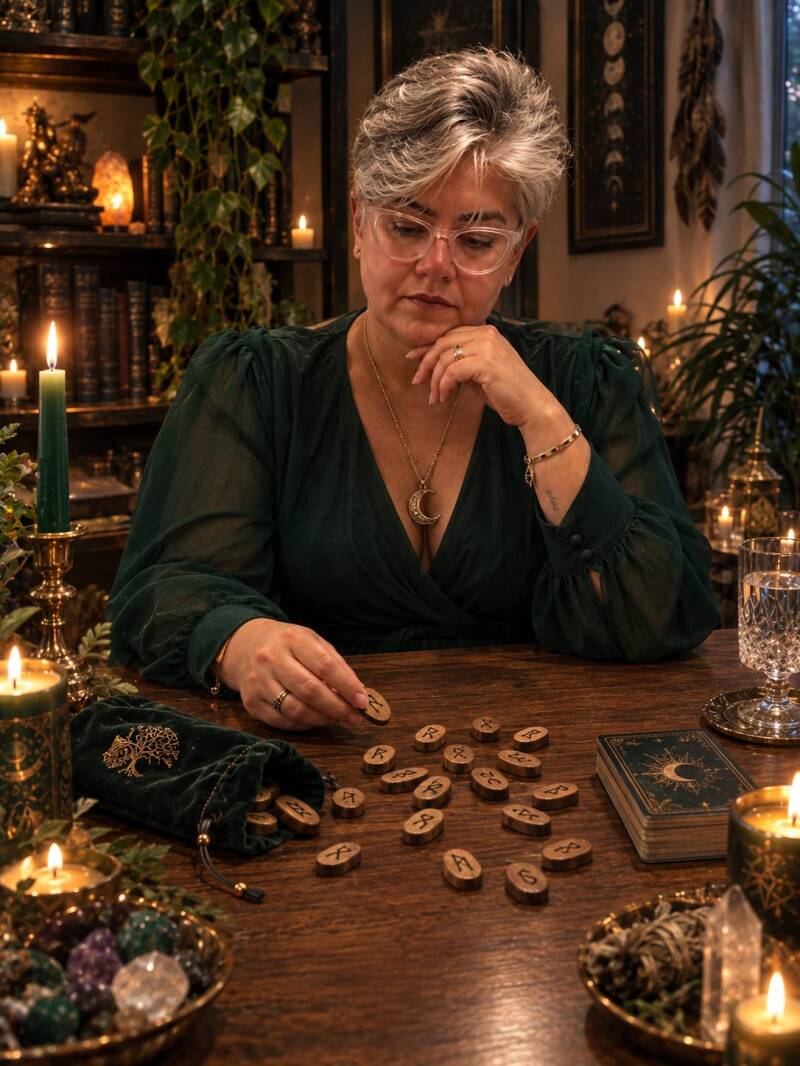
I now have my own bag of runes, and there is something wonderfully tactile about physically reaching into the bag and selecting one.
It's different from scrolling through something on a screen.
You have to stop.
You have to touch the runes.
You have to choose.
And sometimes I'll hold the bag and allow my intuition to guide me before I even pull anything.
Which rune feels like it wants to come out?
Which one catches my attention?
What happens when I turn it over?
And then I look at the traditional symbolism.
It's almost like having two conversations at once:
One with the ancient symbolism...
…and one with my intuition.
My favourite way to read
I love a simple three-rune spread. Nothing complicated. No need to build an altar the size of Stonehenge. Although, obviously, I'm not going to complain if there are candles involved!
One of my favourite spreads is:
ᚠ Past
What energy has brought me here?
ᚨ Present
What am I being shown right now?
ᛞ Guidance
What do I need to know as I move forward?
And then I allow the runes to speak as a story.
Because one rune on its own can say one thing.
Three runes together can create an entirely different conversation.
For example, imagine pulling:
Isa → Nauthiz → Dagaz
Stillness → restriction → breakthrough.
To me, that tells a very different story from simply saying:
"You're stuck."
It could be:
"You're being asked to stop forcing the situation. This pause is teaching you something. Stay with it — because the energy is moving towards a breakthrough."
That's where interpretation becomes intuitive.
Runes aren't about predicting your future
This is probably the biggest thing I would say to anyone who is curious about rune readings.
Don't give your power away.
A rune isn't your boss. It isn't your destiny carved in stone. And it certainly isn't there to scare you.
Even a rune associated with disruption or difficulty isn't necessarily "bad."
Sometimes Hagalaz, associated with disruption and upheaval, can represent the thing that finally shakes loose what you've been clinging to.
Sometimes Isa, the rune of stillness, is exactly what you need when you're desperately trying to force an answer.
Sometimes Nauthiz, associated with need and restriction, highlights a lesson around boundaries, patience or resilience.
And sometimes Dagaz arrives like that gorgeous moment when the lights finally come on.
Ohhhh. NOW I get it.
That's the beauty of symbolic work.
Why I love working with runes
For me, runes are a beautiful bridge between ancient wisdom and modern intuition.
They remind us that humans have always searched for meaning.
We've looked at nature.
We've watched the seasons.
We've observed patterns.
We've asked questions.
We've looked beyond what we can immediately see.
And although our modern lives may involve smartphones, emails, Google calendars and approximately 47 passwords we can never remember...
we're still human.
We still want guidance.
We still want meaning.
We still want to understand ourselves.
And sometimes we still need a little nudge from the universe.
Maybe that nudge comes through a rune.
Maybe it comes through a feeling.
Maybe it comes through a conversation.
Maybe it comes through a completely random moment when you're driving and suddenly realise you've been ignoring something your intuition has been screaming at you about for six months.
We've all been there!
Your invitation to explore
You don't have to be a Viking.
You don't have to know Old Norse.
You don't have to be an expert.
And you definitely don't need to grow a magnificent beard and sail across the North Sea.
You simply need curiosity.
Start with one rune.
Hold it.
Look at it.
Learn its traditional meaning.
Then ask yourself:
What does this symbol mean to me?
What does it make me feel?
Where does this energy show up in my life?
Because perhaps the most beautiful thing about working with runes isn't discovering what the future holds.
Perhaps it's discovering more of yourself.
And that, for me, is where the real magic begins.
The rune gives you the symbol.
Your intuition gives it meaning.
And you get to choose what you do with the message.
Add comment
Comments